|
Let's
get straight to the heart of the matter--the
heart's job is to move blood.
Day
and night, the muscles of your heart
contract and relax to pump blood throughout
your body. When blood returns to the
heart, it follows a complicated pathway.
If you were in the bloodstream, you
would follow the steps below one by
one.
|
|
|
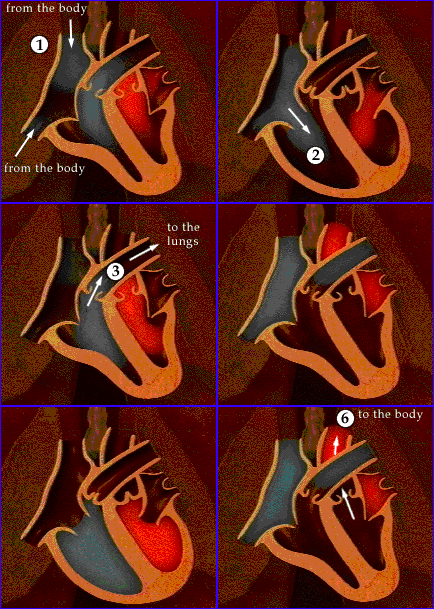
1. |
Oxygen-poor
blood (shown in blue) flows
from the body into the right
atrium. |
|
2. |
Blood
flows through the right
atrium into the right ventricle. |
|
3. |
The right ventricle pumps
the blood to the lungs,
where the blood releases
waste gases and picks up
oxygen. |
|
4. |
The
newly oxygen-rich blood
(shown in red) returns to
the heart and enters the
left atrium. |
|
5. |
Blood flows through the
left atrium into the left
ventricle. |
|
6. |
The
left ventricle pumps the
oxygen-rich blood to all
parts of the body. |
|
| |
|
|
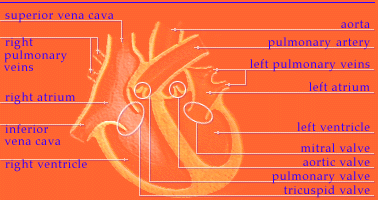
Do
right and left seem backward?
That's because you're looking
at an illustration of somebody
else's heart. To think about
how your own heart works, imagine
wearing this illustration on
your chest. |
Sure,
you know how to steal hearts, win
hearts, and break hearts. But how
much do you really know about your
heart and how it works? Read on to
your heart's content!
Put
your hand on your heart. Did you place
your hand on the left side of your
chest? Many people do, but the heart
is actually located almost in the
center of the chest, between the lungs.
It's tipped slightly so that a part
of it sticks out and taps against
the left side of the chest, which
is what makes it seem as though it
is located there.
Hold
out your hand and make a fist. If
you're a kid, your heart is about
the same size as your fist, and if
you're an adult, it's about the same
size as two fists.
Your
heart beats about 100,000 times in
one day and about 35 million times
in a year. During an average lifetime,
the human heart will beat more than
2.5 billion times.
Give
a tennis ball a good, hard squeeze.
You're using about the same amount
of force your heart uses to pump blood
out to the body. Even at rest, the
muscles of the heart work hard--twice
as hard as the leg muscles of a person
sprinting.
Feel
your pulse by placing two fingers
at pulse points on your neck or wrists.
The pulse you feel is blood stopping
and starting as it moves through your
arteries. As a kid, your resting pulse
might range from 90 to 120 beats per
minute. As an adult, your pulse rate
slows to an average of 72 beats per
minute.
The
aorta, the largest artery in the body,
is almost the diameter of a garden
hose. Capillaries, on the other hand,
are so small that it takes ten of
them to equal the thickness of a human
hair.
Your
body has about 5.6 liters (6 quarts)
of blood. This 5.6 liters of blood
circulates through the body three
times every minute. In one day, the
blood travels a total of 19,000 km
(12,000 miles)-- that's four times
the distance across the US from coast
to coast.
The
heart pumps about 1 million barrels
of blood during an average lifetime--that's
enough to fill more than 3 super tankers.
lub-DUB,
lub-DUB, lub-DUB. Sound familiar?
If you listen to your heart beat,
you'll hear two sounds. These "lub"
and "DUB" sounds are made by the heart
valves as they open and close. |